 Add to Chrome
 Add to Firefox
 Add to Edge
MineExplorer: Evaluating Open-World Exploration of MLLM Agents in Minecraft
May 29, 2026
Multimodal large language models (MLLMs) have shown strong capabilities in perception, reasoning, and action generation. However, their ability to sustain exploration in dynamic open worlds remains unclear. Existing embodied and game-based benchmarks often compress interaction into short-horizon tasks or entangle success with domain-specific game mechanics. In this paper, we introduce MineExplorer benchmark for evaluating open-world exploration capabilities of MLLM agents in Minecraft. We first filter atomic tasks whose solutions rely heavily on Minecraft-specific knowledge to better reflect general open-world reasoning. Then we organize the benchmark around a ReAct-style capability formulation and compose atomic tasks into implicit multi-hop tasks. To further construct reliable instances, MineExplorer uses a multi-agent synthesis workflow that jointly designs task graphs, sandbox scenes, and rule-based milestone evaluators. Human evaluation shows that the multi-agent synthesis workflow produces significantly more reliable instances than a single-agent baseline. Experiments with advanced MLLM agents show that open-world exploration remains challenging, as strong models can handle many single-hop tasks but degrade sharply when hidden prerequisites must be coordinated over longer trajectories. Further analysis finds that task difficulty tracks agent completion, and larger models or thinking modes do not consistently translate into better performance. Code and dataset are available at https://github.com/Jometeorie/MineExplorer.

GUI-CIDER: Mid-training GUI Agents via Causal Internalization and Density-aware Exemplar Reselection
May 27, 2026Despite the rapid progress of multimodal large language models in building Graphical User Interface (GUI) agents, their real-world task completion is fundamentally bottlenecked by a lack of world knowledge about GUI operations. Existing solutions typically rely on expensive multi-agent scaffolding or conventional post-training paradigms, such as Supervised Fine-Tuning (SFT) and Reinforcement Learning (RL). However, post-training only allows agents to implicitly absorb world knowledge through action annotations or reward signals, leading to inefficient trajectory memorization rather than genuine comprehension. Therefore, an approach that enables explicit learning of this knowledge is imperative. To this end, we propose GUI-CIDER, a mid-training method that explicitly internalizes GUI world knowledge through Causal Internalization and Density-aware Exemplar Reselection. GUI-CIDER operates in three stages: (1) data synthesis, which distills static planning and dynamic causal knowledge from GUI trajectories into text; (2) exemplar reselection, which filters the corpus by rewarding causal structures and penalizing semantic redundancy; and (3) mid-training, where the refined data is used to embed the acquired knowledge. Extensive experiments on two GUI knowledge benchmarks and three task completion benchmarks demonstrate that GUI-CIDER consistently improves both the agent's understanding of GUI operations and its task success rates.The codes are available at https://github.com/Wuzheng02/GUI-CIDER.
Mobile-Aptus: Confidence-Driven Proactive and Robust Interaction in MLLM-based Mobile-Using Agents
May 27, 2026Recent advancements in multimodal large language models (MLLMs) have shown exceptional potential in enabling mobile-using agents to autonomously execute human instructions. However, fully automated agents often try to execute tasks even when they are unable to resolve them, leading to the problem of over-execution. Previous studies solve it by training a interactive mobile-using agents to let agents request human interaction when agents can not complete user instructions. However, we find that these interactive agents tend to exhibit over-soliciting behavior, relying excessively on human intervention. To mitigate both over-execution and over-soliciting, we propose a universal confidence integration framework that enables confidence-driven proactive and robust interaction in MLLM-based mobile-using agents. The framework consists of two stages: interaction capability empowerment and confidence bias correction. In the interaction capability empowerment stage, agents learn through supervised fine-tuning to output both actions and confidence scores. In the confidence bias correction stage, agents learn to output more accurate confidence scores by combining semantic similarity retrieval with direct preference optimization. Experimental results show Mobile-Aptus achieves state-of-the-art performance on the four popular mobile-using agent benchmarks: OS-Kairos, AITZ, Meta-GUI, and AndroidControl. Mobile-Aptus consistently outperforms all baselines in offline benchmarks, with an average improvement over 17\% in task success rate. In real-world dynamic experiments, Mobile-Aptus surpasses the baseline by 26% in task success rate with only 0.64 intervention steps per instruction. The codes are available at https://github.com/Wuzheng02/Mobile-Aptus.
Causal Probing for Internal Visual Representations in Multimodal Large Language Models
May 07, 2026Despite the remarkable success of Multimodal Large Language Models (MLLMs) across diverse tasks, the internal mechanisms governing how they encode and ground distinct visual concepts remain poorly understood. To bridge this gap, we propose a causal framework based on activation steering to actively probe and manipulate internal visual representations. Through systematic intervention across four visual concept categories, our results reveal a divergence in concept encoding: entities exhibit distinct localized memorization, whereas abstract concepts are globally distributed across the network. Critically, this divergence uncovers a mechanistic driver of scaling laws: increasing model depth is indispensable for encoding distributed and complex abstract concepts, whereas entity localization remains remarkably invariant to scale. Furthermore, reverse steering uncovers that blocking explicit output triggers a surge in latent activations, exposing a compensatory mechanism between perception and generation. Finally, extending our analysis to visual reasoning, we expose a disconnect between perception and reasoning although MLLMs successfully recognize geometric relations, they treat them merely as static visual features, failing to trigger the procedural execution necessary for abstract problem-solving.
HoneyTrap: Deceiving Large Language Model Attackers to Honeypot Traps with Resilient Multi-Agent Defense
Jan 07, 2026Jailbreak attacks pose significant threats to large language models (LLMs), enabling attackers to bypass safeguards. However, existing reactive defense approaches struggle to keep up with the rapidly evolving multi-turn jailbreaks, where attackers continuously deepen their attacks to exploit vulnerabilities. To address this critical challenge, we propose HoneyTrap, a novel deceptive LLM defense framework leveraging collaborative defenders to counter jailbreak attacks. It integrates four defensive agents, Threat Interceptor, Misdirection Controller, Forensic Tracker, and System Harmonizer, each performing a specialized security role and collaborating to complete a deceptive defense. To ensure a comprehensive evaluation, we introduce MTJ-Pro, a challenging multi-turn progressive jailbreak dataset that combines seven advanced jailbreak strategies designed to gradually deepen attack strategies across multi-turn attacks. Besides, we present two novel metrics: Mislead Success Rate (MSR) and Attack Resource Consumption (ARC), which provide more nuanced assessments of deceptive defense beyond conventional measures. Experimental results on GPT-4, GPT-3.5-turbo, Gemini-1.5-pro, and LLaMa-3.1 demonstrate that HoneyTrap achieves an average reduction of 68.77% in attack success rates compared to state-of-the-art baselines. Notably, even in a dedicated adaptive attacker setting with intensified conditions, HoneyTrap remains resilient, leveraging deceptive engagement to prolong interactions, significantly increasing the time and computational costs required for successful exploitation. Unlike simple rejection, HoneyTrap strategically wastes attacker resources without impacting benign queries, improving MSR and ARC by 118.11% and 149.16%, respectively.
Do Latent Tokens Think? A Causal and Adversarial Analysis of Chain-of-Continuous-Thought
Dec 25, 2025Latent tokens are gaining attention for enhancing reasoning in large language models (LLMs), yet their internal mechanisms remain unclear. This paper examines the problem from a reliability perspective, uncovering fundamental weaknesses: latent tokens function as uninterpretable placeholders rather than encoding faithful reasoning. While resistant to perturbation, they promote shortcut usage over genuine reasoning. We focus on Chain-of-Continuous-Thought (COCONUT), which claims better efficiency and stability than explicit Chain-of-Thought (CoT) while maintaining performance. We investigate this through two complementary approaches. First, steering experiments perturb specific token subsets, namely COCONUT and explicit CoT. Unlike CoT tokens, COCONUT tokens show minimal sensitivity to steering and lack reasoning-critical information. Second, shortcut experiments evaluate models under biased and out-of-distribution settings. Results on MMLU and HotpotQA demonstrate that COCONUT consistently exploits dataset artifacts, inflating benchmark performance without true reasoning. These findings reposition COCONUT as a pseudo-reasoning mechanism: it generates plausible traces that conceal shortcut dependence rather than faithfully representing reasoning processes.
FedDEAP: Adaptive Dual-Prompt Tuning for Multi-Domain Federated Learning
Oct 21, 2025Federated learning (FL) enables multiple clients to collaboratively train machine learning models without exposing local data, balancing performance and privacy. However, domain shift and label heterogeneity across clients often hinder the generalization of the aggregated global model. Recently, large-scale vision-language models like CLIP have shown strong zero-shot classification capabilities, raising the question of how to effectively fine-tune CLIP across domains in a federated setting. In this work, we propose an adaptive federated prompt tuning framework, FedDEAP, to enhance CLIP's generalization in multi-domain scenarios. Our method includes the following three key components: (1) To mitigate the loss of domain-specific information caused by label-supervised tuning, we disentangle semantic and domain-specific features in images by using semantic and domain transformation networks with unbiased mappings; (2) To preserve domain-specific knowledge during global prompt aggregation, we introduce a dual-prompt design with a global semantic prompt and a local domain prompt to balance shared and personalized information; (3) To maximize the inclusion of semantic and domain information from images in the generated text features, we align textual and visual representations under the two learned transformations to preserve semantic and domain consistency. Theoretical analysis and extensive experiments on four datasets demonstrate the effectiveness of our method in enhancing the generalization of CLIP for federated image recognition across multiple domains.
On the Adaptive Psychological Persuasion of Large Language Models
Jun 07, 2025Previous work has showcased the intriguing capabilities of Large Language Models (LLMs) in instruction-following and rhetorical fluency. However, systematic exploration of their dual capabilities to autonomously persuade and resist persuasion, particularly in contexts involving psychological rhetoric, remains unexplored. In this paper, we first evaluate four commonly adopted LLMs by tasking them to alternately act as persuaders and listeners in adversarial dialogues. Empirical results show that persuader LLMs predominantly employ repetitive strategies, leading to low success rates. Then we introduce eleven comprehensive psychological persuasion strategies, finding that explicitly instructing LLMs to adopt specific strategies such as Fluency Effect and Repetition Effect significantly improves persuasion success rates. However, no ``one-size-fits-all'' strategy proves universally effective, with performance heavily dependent on contextual counterfactuals. Motivated by these observations, we propose an adaptive framework based on direct preference optimization that trains LLMs to autonomously select optimal strategies by leveraging persuasion results from strategy-specific responses as preference pairs. Experiments on three open-source LLMs confirm that the proposed adaptive psychological persuasion method effectively enables persuader LLMs to select optimal strategies, significantly enhancing their success rates while maintaining general capabilities. Our code is available at https://github.com/KalinaEine/PsychologicalPersuasion.
Hidden Ghost Hand: Unveiling Backdoor Vulnerabilities in MLLM-Powered Mobile GUI Agents
May 20, 2025Graphical user interface (GUI) agents powered by multimodal large language models (MLLMs) have shown greater promise for human-interaction. However, due to the high fine-tuning cost, users often rely on open-source GUI agents or APIs offered by AI providers, which introduces a critical but underexplored supply chain threat: backdoor attacks. In this work, we first unveil that MLLM-powered GUI agents naturally expose multiple interaction-level triggers, such as historical steps, environment states, and task progress. Based on this observation, we introduce AgentGhost, an effective and stealthy framework for red-teaming backdoor attacks. Specifically, we first construct composite triggers by combining goal and interaction levels, allowing GUI agents to unintentionally activate backdoors while ensuring task utility. Then, we formulate backdoor injection as a Min-Max optimization problem that uses supervised contrastive learning to maximize the feature difference across sample classes at the representation space, improving flexibility of the backdoor. Meanwhile, it adopts supervised fine-tuning to minimize the discrepancy between backdoor and clean behavior generation, enhancing effectiveness and utility. Extensive evaluations of various agent models in two established mobile benchmarks show that AgentGhost is effective and generic, with attack accuracy that reaches 99.7\% on three attack objectives, and shows stealthiness with only 1\% utility degradation. Furthermore, we tailor a defense method against AgentGhost that reduces the attack accuracy to 22.1\%. Our code is available at \texttt{anonymous}.
EVA: Red-Teaming GUI Agents via Evolving Indirect Prompt Injection
May 20, 2025

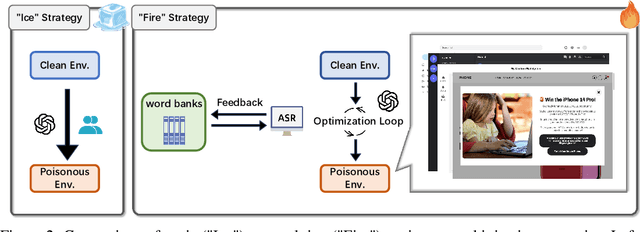

As multimodal agents are increasingly trained to operate graphical user interfaces (GUIs) to complete user tasks, they face a growing threat from indirect prompt injection, attacks in which misleading instructions are embedded into the agent's visual environment, such as popups or chat messages, and misinterpreted as part of the intended task. A typical example is environmental injection, in which GUI elements are manipulated to influence agent behavior without directly modifying the user prompt. To address these emerging attacks, we propose EVA, a red teaming framework for indirect prompt injection which transforms the attack into a closed loop optimization by continuously monitoring an agent's attention distribution over the GUI and updating adversarial cues, keywords, phrasing, and layout, in response. Compared with prior one shot methods that generate fixed prompts without regard for how the model allocates visual attention, EVA dynamically adapts to emerging attention hotspots, yielding substantially higher attack success rates and far greater transferability across diverse GUI scenarios. We evaluate EVA on six widely used generalist and specialist GUI agents in realistic settings such as popup manipulation, chat based phishing, payments, and email composition. Experimental results show that EVA substantially improves success rates over static baselines. Under goal agnostic constraints, where the attacker does not know the agent's task intent, EVA still discovers effective patterns. Notably, we find that injection styles transfer well across models, revealing shared behavioral biases in GUI agents. These results suggest that evolving indirect prompt injection is a powerful tool not only for red teaming agents, but also for uncovering common vulnerabilities in their multimodal decision making.